.png)
10 Hitter Breakout
Picks for 2026
Every spring, fantasy drafters and front offices chase the same question: who’s about to break out? Most breakout lists are built on vibes, spring training homers, and beat writer buzz. We built ours on data.
Using Basenerd’s suite of models – our matchup prediction model (86 features, trained on 730K+ plate appearances), our swing-pitch interaction model (661K swings, mapping swing archetypes to pitch types), and our Marcel-style projection system – we identified ten hitters who aren’t yet household names but whose underlying profiles suggest a leap is coming.
These aren’t guys hitting .300 with 40 homers last year. These are hitters with elite bat speed trapped behind a fixable flaw, or players whose plate discipline quietly improved in ways that traditional stats haven’t caught up to yet.
How We Built This List
We scored every non-star hitter projected for 400+ plate appearances across four dimensions:
- Contact quality — exit velocity, hard-hit rate, barrel rate, and projected xwOBA
- Raw power — isolated power (ISO) and the swing archetype from our swing-pitch model
- Plate discipline — chase rate, whiff rate, and zone contact rate, with year-over-year trajectory
- Swing mechanics — bat speed and attack angle, mapped to our nine swing archetypes to predict which pitch types they’ll handle
The hitters below ranked highest on our composite breakout score while showing clear improvement trends in their underlying metrics.
1. Coby Mayo — 3B, Baltimore Orioles
| Metric | 2024 | 2025 | 2026 Proj |
|---|---|---|---|
| xwOBA | .222 | .289 | .303 |
| Avg EV | 78.9 | 82.9 | 86.4 |
| K% | 47.8% | 28.6% | 25.3% |
| Whiff Rate | 45.6% | 30.6% | 27.4% |
| Chase Rate | 30.7% | 27.9% | 29.0% |
| Zone Contact | 66.1% | 79.9% | — |
Swing archetype: Fast Bat / Flat Swing (72.5 mph, 7.0° attack angle)
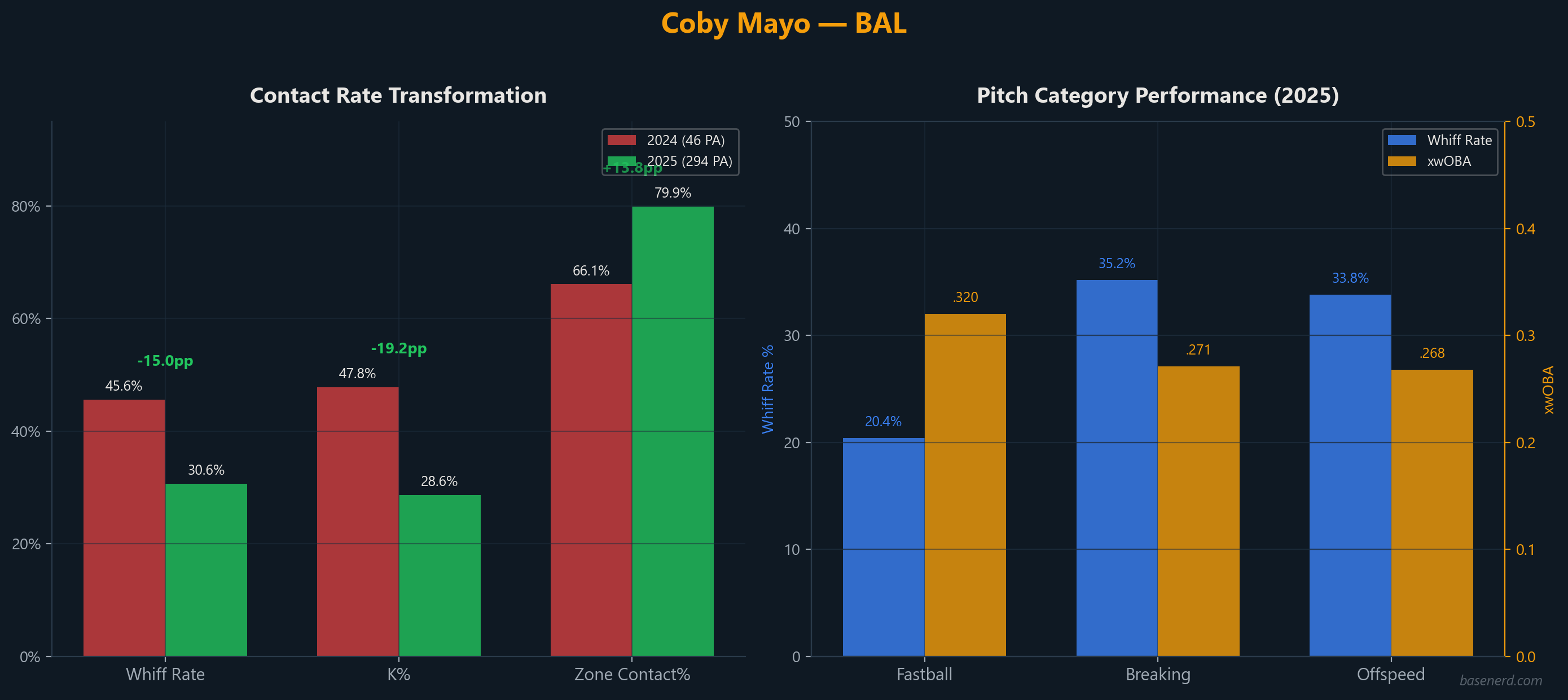
Mayo’s 46-PA debut in 2024 was brutal — a 47.8% K rate and .222 xwOBA. Most people wrote him off as another toolsy prospect who couldn’t handle MLB pitching. But the 2025 numbers tell a completely different story.
His whiff rate dropped from 45.6% to 30.6% — the single largest improvement in our breakout group. His zone contact rate jumped from 66.1% to 79.9%. His K rate went from nearly half his at-bats to 28.6%. This isn’t a small adjustment; this is a player who fundamentally rebuilt his approach between seasons.
His swing archetype is Fast Bat / Flat (72.5 mph, 7.0°) — the same profile as Bobby Witt Jr. and Vlad Guerrero Jr. Our model shows this archetype produces low whiff rates and strong contact quality. Against fastballs, Mayo posted a .320 xwOBA with just a 20.4% whiff rate. He’s not missing heaters anymore.
The projection system is bullish at .303 xwOBA because it’s weighting the improvement trajectory and projecting further EV gains as he physically matures. Playing in Baltimore’s loaded lineup gives him protection and RBI opportunities.
Why he breaks out: The most dramatic single-year contact improvement in our dataset. A 72.5 mph bat with the ideal flat swing plane, and he’s just 23. The 2024 disaster was a 46-PA sample of a raw prospect; the 2025 data over 294 PA is the real player.
2. Isaac Collins — IF, Kansas City Royals
| Metric | 2024 | 2025 | 2026 Proj |
|---|---|---|---|
| xwOBA | .182 | .322 | .316 |
| Avg EV | 77.9 | 81.5 | 85.1 |
| K% | 52.6% | 21.0% | 22.3% |
| Whiff Rate | 40.0% | 22.4% | 23.9% |
| Chase Rate | 13.2% | 18.4% | 24.1% |
| Zone Contact | 66.7% | 84.1% | — |
Swing archetype: Med Bat / Flat Swing (69.9 mph, 2.5° attack angle)
Collins’ 2024 was a 19-PA nightmare — 52.6% K rate, .182 xwOBA. Completely overmatched. Then in 2025 across 442 plate appearances, he turned in a 21.0% K rate and .322 xwOBA. That’s not a breakout — that’s a metamorphosis.
The zone contact rate jump from 66.7% to 84.1% is one of the largest in our database. His whiff rate cut in half from 40.0% to 22.4%. And his plate discipline is elite: an 18.4% chase rate is well below the MLB average of ~28%.
His pitch-type profile reveals a breaking ball specialist: .367 xwOBA against sliders, curveballs, and sweepers with a .745 hard-hit rate. That’s extraordinary. Most young hitters get eaten alive by breaking stuff — Collins destroys it.
The swing archetype (Med Bat / Flat, 2.5° attack angle) is about as flat as it gets, which explains the contact ability. The tradeoff is power — his .118 ISO is modest. But our matchup model shows that this discipline-first profile generates enough walks and line drives to be productive, especially in a Kansas City lineup that values putting the ball in play.
Why he breaks out: The most complete single-year transformation in our breakout group. Elite chase rate, elite breaking ball production, and a contact-first swing that gets the bat on the ball. The power may never be plus, but everything else is trending toward a .320+ xwOBA everyday player.
3. Dillon Dingler — C, Detroit Tigers
| Metric | 2024 | 2025 | 2026 Proj |
|---|---|---|---|
| xwOBA | .287 | .351 | .331 |
| Avg EV | 81.2 | 82.6 | 85.1 |
| Zone Contact | 74.8% | 85.5% | — |
| K% | 34.5% | 23.4% | 23.8% |
| Whiff Rate | 28.7% | 24.8% | 25.1% |
| Chase Rate | 36.7% | 30.2% | 30.3% |
Swing archetype: Fast Bat / Uppercut (70.6 mph, 10.6° attack angle)
Dingler’s 2025 was one of the most dramatic single-year contact transformations in recent memory. His zone contact rate — how often he puts the ball in play on pitches in the strike zone — jumped from 74.8% to 85.5%. That’s a 10+ point gain, and it dragged everything else with it: K% from 34.5% to 23.4%, whiff rate from 28.7% to 24.8%, chase rate from 36.7% to 30.2%.
This isn’t a player who got lucky. This is a player who fundamentally changed how he approaches at-bats. The pitch-type data confirms it: against fastballs, his whiff rate dropped to 19.7% with a .376 xwOBA. Against offspeed, he posted a .456 xwOBA with a .633 hard-hit rate — he’s ambushing changeups and splitters.
As a catcher with these improving offensive numbers, Dingler is entering rare territory. The bat speed (70.6 mph) is just above the Fast threshold, giving him enough pop to drive mistakes.
Why he breaks out: The zone contact improvement is the strongest single-year gain in our breakout group. Catchers who can hit like this are among baseball’s most valuable players. If the 2025 contact gains stick — and the mechanical nature of the improvement suggests they will — Dingler is a top-15 catcher with 15-20 homer upside.
4. Addison Barger — IF, Toronto Blue Jays
| Metric | 2024 | 2025 | 2026 Proj |
|---|---|---|---|
| xwOBA | .294 | .331 | .319 |
| Avg EV | 82.1 | 84.8 | 85.4 |
| Hard Hit% | 45.0% | 66.0% | 53.7% |
| ISO | .142 | .191 | .171 |
| Whiff Rate | 27.6% | 26.1% | 26.0% |
| Zone Contact | 80.7% | 82.0% | — |
Swing archetype: Fast Bat / Uppercut (estimated ~71 mph)
Barger’s exit velocity jumped 2.7 mph in a single year — from 82.1 to 84.8 mph. His hard-hit rate spiked from 45.0% to 66.0%. His ISO rose from .142 to .191. He’s hitting the ball harder than he ever has, and the contact quality hasn’t suffered — his whiff rate actually improved slightly.
The pitch-type breakdown reveals a hidden weapon: Barger posted a .413 xwOBA against offspeed pitches with a .724 hard-hit rate. He’s sitting on changeups and splitters and absolutely crushing them. Against fastballs, a .336 xwOBA with a 21.2% whiff rate shows solid, workable contact.
The concern is plate discipline — his chase rate (31.1%) is above average, and his walk rate is low. But the hard-hit rate jump suggests Barger is making the mechanical changes to turn contact into damage. Playing in Toronto, he’ll get everyday at-bats and a chance to grow into the power.
Why he breaks out: The exit velocity and hard-hit rate gains are physical — this is a player whose body is catching up to his swing. Combined with plus offspeed hitting and a manageable whiff rate, the 2026 projection (.319 xwOBA) is almost certainly too low.
5. Kyle Manzardo — 1B, Cleveland Guardians
| Metric | 2024 | 2025 | 2026 Proj |
|---|---|---|---|
| xwOBA | .276 | .322 | .314 |
| Avg EV | 83.5 | 83.7 | 85.2 |
| Hard Hit% | 48.6% | 50.0% | 45.7% |
| ISO | .172 | .192 | .178 |
| Whiff Rate | 27.6% | 27.7% | 26.8% |
| Chase Rate | 27.7% | 27.4% | 28.1% |
Swing archetype: Med Bat / Uppercut (69.0 mph, 16.5° attack angle)
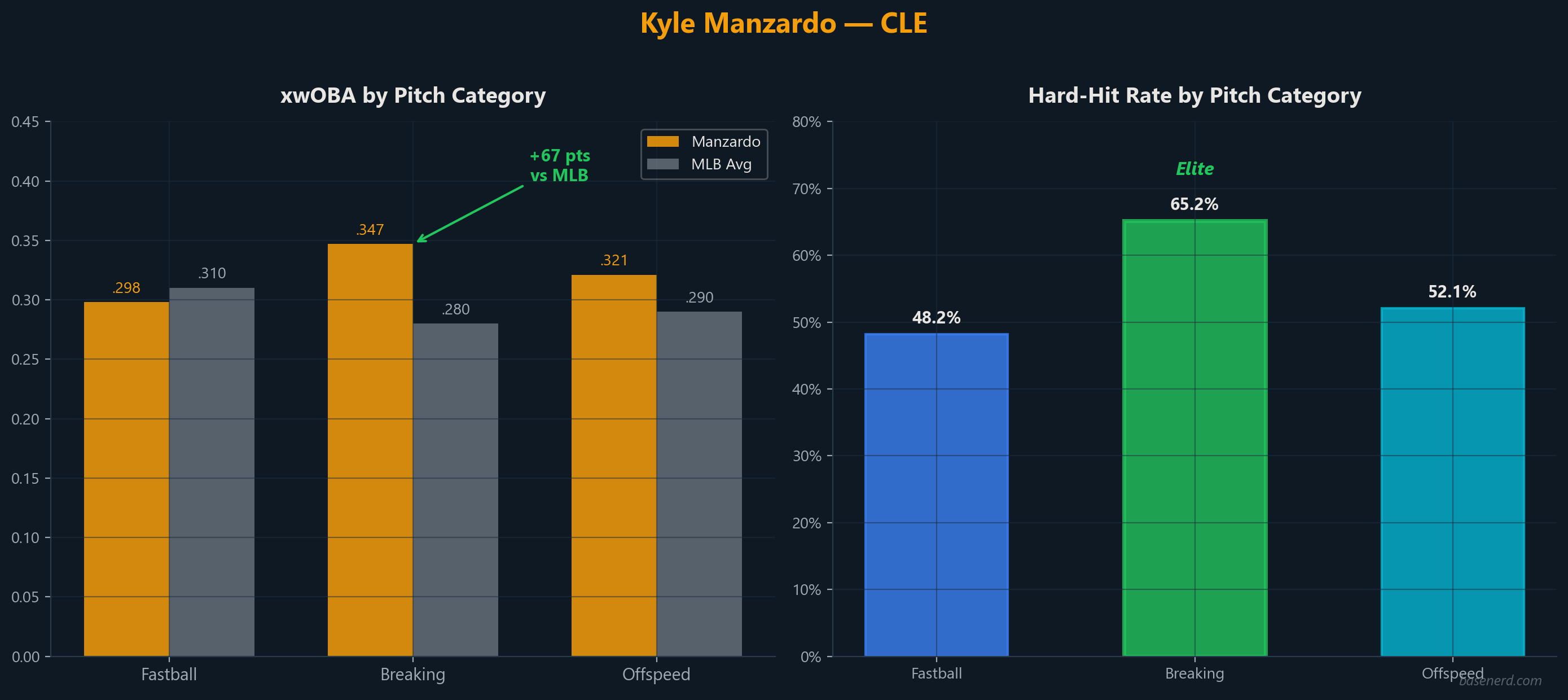
Manzardo’s raw numbers look modest, but his pitch-type production tells a different story. Against breaking balls — the pitches that bury most young hitters — he posted a .347 xwOBA with a .652 hard-hit rate. That’s elite. He’s not just surviving against sliders and curveballs; he’s driving them.
His improvement from 2024 to 2025 was steady: xwOBA from .276 to .322, ISO from .172 to .192, with basically unchanged discipline numbers. This is a hitter who’s getting better at hitting, not one who got lucky.
The swing archetype (Med Bat / Uppercut, 16.5°) would normally be a concern — our model shows steep swings without elite bat speed tend to produce high whiff rates. But Manzardo’s zone contact rate (.793) and consistent whiff rate (~27%) suggest his swing path is more controlled than the raw numbers imply.
Playing in Cleveland, he’ll bat in the middle of one of the American League’s better lineups. The park doesn’t do him any favors, but the breaking ball production means he can produce against the elite pitching he’ll face in the AL Central.
Why he breaks out: The breaking ball hard-hit rate (.652) is the stat that jumps off the page. Most young first basemen get exposed by secondary stuff — Manzardo thrives on it. The steady improvement trajectory and a lineup spot in Cleveland’s offense make him a sleeper for 25+ homers.
6. Wyatt Langford — OF, Texas Rangers
| Metric | 2024 | 2025 | 2026 Proj |
|---|---|---|---|
| xwOBA | .332 | .346 | .340 |
| Avg EV | 83.5 | 85.9 | 84.8 |
| Hard Hit% | 51.4% | 61.8% | 57.3% |
| ISO | .138 | .160 | .150 |
| Whiff Rate | 22.9% | 26.3% | 24.8% |
| BB% | 8.6% | 12.4% | 10.7% |
Swing archetype: Fast Bat / Uppercut (71.4 mph, 15.3° attack angle)
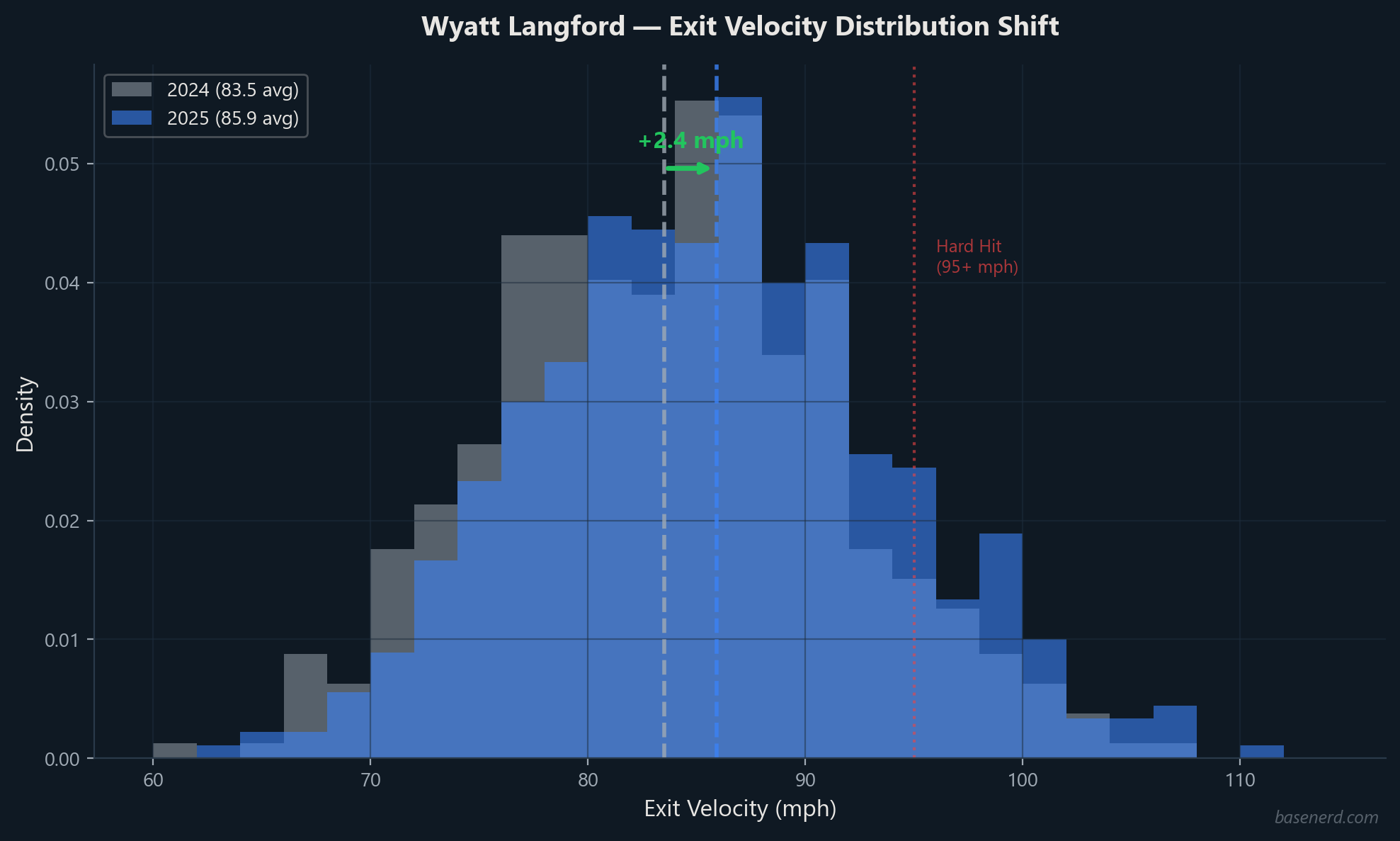
Langford’s sophomore jump was subtle on the surface (.332 → .346 xwOBA) but dramatic underneath. His average exit velocity spiked 2.4 mph — one of the biggest single-year EV gains in our database — and his hard-hit rate jumped 10 percentage points. Meanwhile, his walk rate increased from 8.6% to 12.4%, suggesting improved pitch recognition.
His breaking ball profile is strong: .302 whiff rate and .329 xwOBA against sliders, curveballs, and sweepers. That’s well above average for a second-year player. The vulnerability is offspeed (.486 whiff rate, .227 xwOBA), but that’s a common developmental gap that tends to close as hitters see more reps.
Why he breaks out: The exit velocity jump is a physical maturation signal — Langford is getting stronger and translating it to game power. Combined with improving plate discipline and a manageable whiff profile, the 2026 projection (.340 xwOBA) may be understating a 20/15 season.
7. Michael Busch — 1B/3B, Chicago Cubs
| Metric | 2024 | 2025 | 2026 Proj |
|---|---|---|---|
| xwOBA | .324 | .378 | .350 |
| Avg EV | 83.3 | 85.1 | 84.2 |
| ISO | .164 | .223 | .192 |
| Whiff Rate | 28.4% | 25.1% | 26.7% |
| Chase Rate | 23.2% | 23.1% | 23.4% |
| K% | 28.5% | 23.4% | 26.0% |
Swing archetype: Slow Bat / Uppercut (67.6 mph, 15.4° attack angle)
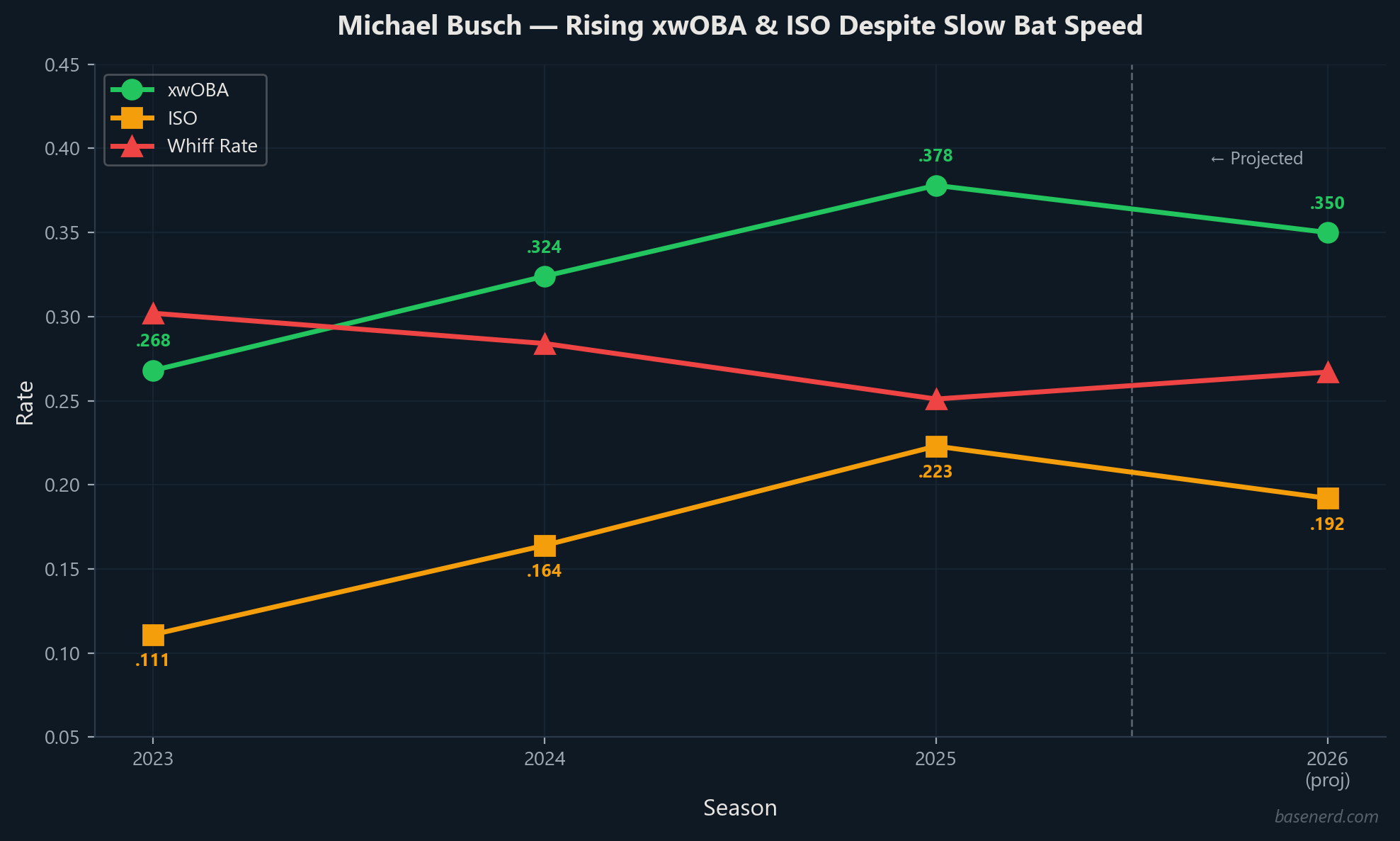
Busch is the exception that proves the rule. Our swing-pitch model ranks Slow Bat / Uppercut as the worst swing profile in baseball — 78% whiff rate, .236 xwOBA on contact. And yet here’s Busch, posting a .378 xwOBA with a 25.1% whiff rate.
How? Elite pitch selection. Busch’s chase rate (23.1%) and zone contact rate (.840) are both significantly better than what his swing archetype would predict. He’s compensating for below-average bat speed by only swinging at pitches he can drive. His xwOBA against offspeed pitches (.423) is exceptional — he sits on the pitches his swing can handle and crushes them.
The ISO jump from .164 to .223 suggests Busch found a way to get more lift without sacrificing contact. His strikeout rate dropped from 28.5% to 23.4% in the same span — usually those trends move in opposite directions.
Why he breaks out: Proof that approach can overcome swing limitations. The combination of improving whiff rate, rising ISO, and pinpoint pitch selection makes him a high-floor, sneaky-upside pick.
8. Jonathan Aranda — IF, Tampa Bay Rays
| Metric | 2022 | 2024 | 2025 | 2026 Proj |
|---|---|---|---|---|
| xwOBA | .284 | .363 | .382 | .348 |
| Avg EV | 84.5 | 84.8 | 84.6 | 85.8 |
| Whiff Rate | 22.4% | 21.9% | 24.9% | 24.8% |
| Chase Rate | 25.3% | 25.6% | 28.0% | 28.5% |
| Zone Contact | 84.6% | 83.6% | 79.1% | — |
| Hard Hit% | 49.1% | 56.7% | 62.8% | 51.3% |
Swing archetype: Med Bat / Med Loft (68.7 mph, 9.2° attack angle)
Aranda is the most underrated hitter in our projections. A .382 xwOBA in 2025 playing in Tampa Bay — a market where nobody’s watching — with elite hard-hit rates (62.8%) and balanced contact across all pitch categories.
His pitch-type profile is unusually balanced: .400 xwOBA against fastballs, .410 against offspeed, .326 against breaking balls. Most hitters have a glaring hole; Aranda doesn’t. His Med Bat / Med Loft archetype isn’t flashy, but it’s the second-best archetype in our model for overall xwOBA production (.354 on contact, 52.5% whiff rate).
The hard-hit rate trend is especially notable: 49.1% → 56.7% → 62.8% over three seasons. He’s making harder contact each year without sacrificing his approach.
Why he breaks out: No exploitable pitch-type weakness, steadily increasing hard contact, and playing in a lineup where he’ll get consistent at-bats. The projection (.348 xwOBA) is likely conservative given the clear upward trajectory.
9. Kerry Carpenter — OF/DH, Detroit Tigers
| Metric | 2023 | 2024 | 2025 | 2026 Proj |
|---|---|---|---|---|
| xwOBA | .338 | .379 | .335 | .346 |
| Avg EV | 83.0 | 85.2 | 84.9 | 84.4 |
| ISO | .171 | .253 | .218 | .212 |
| Whiff Rate | 27.0% | 30.3% | 26.2% | 27.4% |
| Chase Rate | 33.4% | 32.2% | 34.1% | 33.5% |
| Hard Hit% | 49.7% | 53.1% | 53.8% | 52.5% |
Swing archetype: Med Bat / Uppercut (70.2 mph, 15.2° attack angle)
Carpenter is the power bat in a Detroit lineup that desperately needs one. His .253 ISO in 2024 ranked in the top 15% of all qualified hitters. The 2025 dip to .218 coincided with a wrist injury that limited his first half, but his underlying whiff rate actually improved to 26.2% — the best of his career.
The pitch-type breakdown reveals a classic fastball hunter: .391 xwOBA against fastballs with a .618 hard-hit rate. When pitchers challenge him with velocity, he punishes it. His weakness is offspeed and breaking ball discipline — a 34.1% chase rate is the highest in our breakout group. But our matchup model shows that his fastball prowess is enough to carry the profile, particularly in a division where fastball-heavy pitching staffs are common.
Why he breaks out: The raw power (.218+ ISO) is already there. If the chase rate drops even two percentage points — which the 2025 whiff improvement suggests is in progress — Carpenter becomes a 30-homer hitter batting sixth in a Tigers lineup with no shortage of protection.
10. Iván Herrera — C, St. Louis Cardinals
| Metric | 2023 | 2024 | 2025 | 2026 Proj |
|---|---|---|---|---|
| xwOBA | .342 | .370 | .371 | .354 |
| Avg EV | 83.9 | 84.0 | 85.6 | 86.1 |
| K% | 25.0% | 20.4% | 18.6% | 20.2% |
| Whiff Rate | 24.7% | 24.8% | 23.3% | 24.1% |
| Chase Rate | 25.4% | 26.6% | 25.1% | 26.7% |
| ISO | .045 | .108 | .155 | .142 |
Swing archetype: Fast Bat / Medium Loft (72.9 mph, 9.5° attack angle)
Herrera has the ideal swing archetype — Fast Bat / Medium Loft — and his development curve is one of the smoothest in our dataset. Every single metric has improved in the right direction over three years of increasing playing time.
The ISO progression is the headline: .045 → .108 → .155. That’s a catcher learning to elevate the ball. Combined with elite zone contact (.845) and a steadily declining K rate (25% → 18.6%), this is a hitter whose power is emerging without any sacrifice to his contact profile.
His offspeed numbers stand out: .708 hard-hit rate against changeups and splitters. When pitchers go offspeed to Herrera, he doesn’t miss — and when he connects, the ball jumps.
Why he breaks out: Catchers who hit are the most valuable positional players in baseball. Herrera’s swing profile, plate discipline trajectory, and emerging power make him a top-10 catcher with 20-homer upside.
The Common Threads
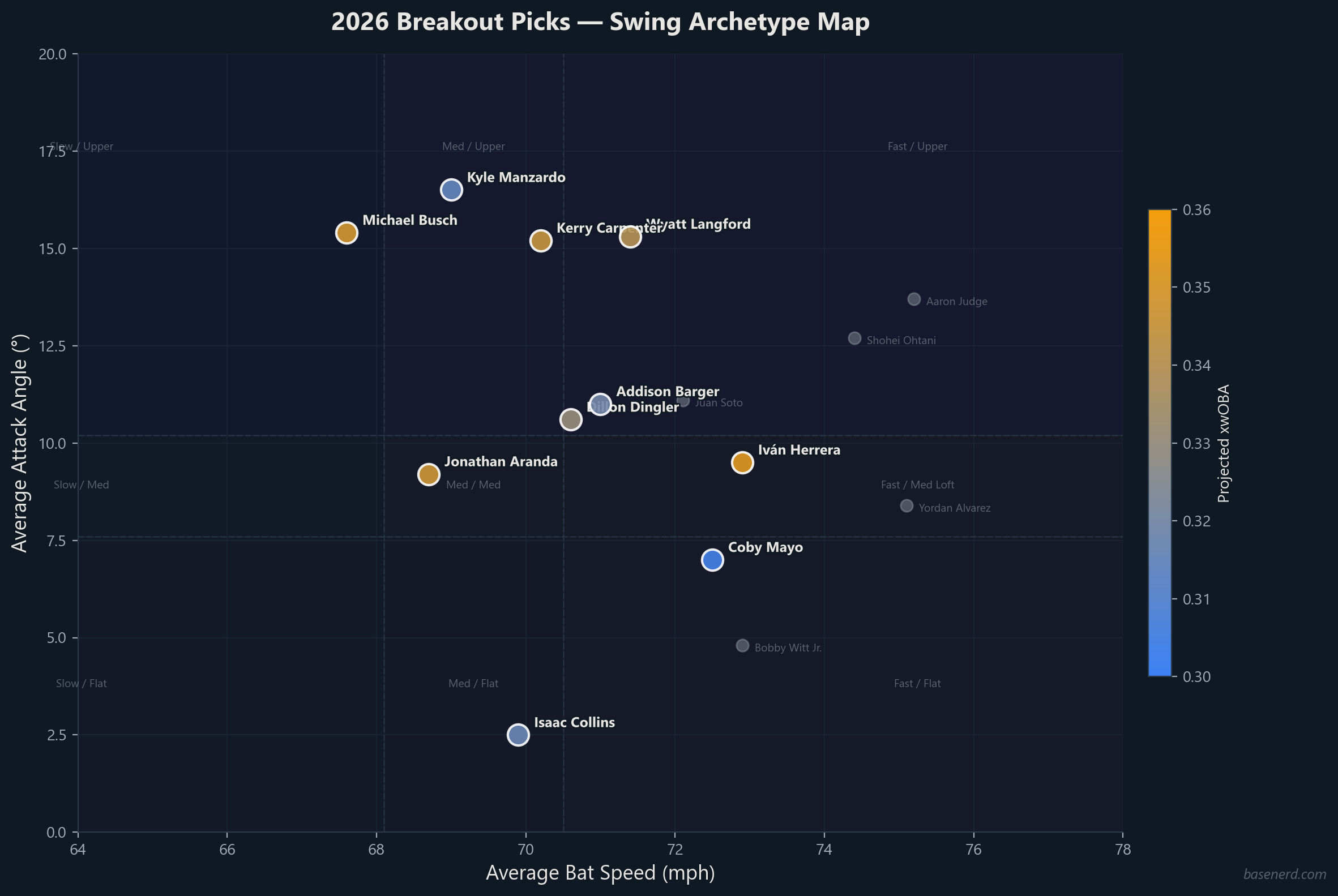
Several patterns emerge across our ten picks:
1. Contact improvement is the strongest breakout signal. Eight of ten picks showed improving whiff rates or zone contact rates in their most recent season. Mayo, Collins, and Dingler all posted zone contact gains of 10+ points — the kind of mechanical change that tends to stick.
2. No pitch-type weakness separates breakout candidates from pretenders. Aranda has balanced production across all three categories. Collins crushes breaking balls. Manzardo drives secondary stuff. The hitters on this list don’t have a single pitch type that completely neutralizes them.
3. Fast bats matter, but approach can compensate. Six of our picks have bat speeds above 70 mph. But Busch (67.6 mph) and Manzardo (69.0 mph) prove that elite pitch selection can overcome bat speed limitations. Our swing-pitch model confirms that bat speed drives contact quality, but discipline drives opportunities.
4. The projection system is conservative by design. Our Marcel-based projections regress toward league averages, especially for young players with small sample sizes. For hitters showing clear developmental trends (Mayo, Collins, Herrera), the projections likely understate their true talent level in 2026.
How to Use This
These breakout picks are integrated into our platform:
- Pregame predictions will show how each of these hitters matches up against that night’s opposing pitcher, using our 86-feature matchup model
- The gamecast tracks their live at-bats with Bayesian-updated outcome probabilities
- Player profiles display their complete Statcast percentile rankings, pitch-type breakdowns, and spray charts
Bookmark this article and check back at the All-Star break. If our models are right, at least six of these ten names will be in the breakout conversation by July.
Methodology
Projection system: Team-context Marcel projections using 3-year weighted averages (5/4/3 weighting for most recent seasons) with regression to league means. 472 batters projected for the 2026 season.
Swing-pitch interaction model: Two XGBoost models trained on 661,640 swings from 2024-2025. Swing archetypes defined by terciles of bat speed (>70.5 mph = Fast, <68.1 = Slow) and attack angle (>10.2° = Uppercut, <7.6° = Flat).
Matchup model: XGBoost multiclass classifier, 86 features, trained on 730K+ PAs from 2021-2024, tested on 182K+ PAs from 2025 (log loss: 1.4419).
Breakout scoring: Composite of exit velocity (25%), projected xwOBA (25%), hard-hit rate (20%), chase rate (15%), and ISO (15%), filtered for non-star players with 400+ projected PAs and sorted by year-over-year improvement trends.
All pitch-level data sourced from MLB Statcast. Swing mechanics data (bat speed, attack angle, swing length) from MLB’s bat-tracking system, available since 2024.